

When Compassion Meets Corporate
Last month I wrote about the risks and concerns over the Executive Director (ED) position in the senior living industry and, it made some waves. You can find it here; Leadership Under Pressure...it highlighted a revolving door on the Executive Director position. The comments were plenty and they pointed to real risk and personal turmoil.
I promised a follow-up discussing compassion fatigue and the juxtaposition with profit. The tension is real and gets spoken about in hushed voices. I’ve been thinking that this is where we might find a breaking point.
Let’s step back a minute to examine the ED role itself as surely there are as many rewards as there are risks.
An ED is the senior leader responsible for the overall operation, culture, financial health, regulatory compliance, and resident experience of a senior living community.
They oversee everything from staffing and clinical coordination to sales, dining, maintenance, and family relations. Every aspect of the senior living community is under the purview of the ED, ensuring residents receive safe, dignified, and person-centered care while maintaining a warm and welcoming environment. They lead and develop staff, manage budgets and occupancy, ensure regulatory compliance, and safeguard the community’s reputation.

Most importantly, they are the steward of the community’s mission: creating a safe, compassionate, and dignified home for older adults—often in their 80s and 90s.
Serving as an Executive Director in senior living is deeply meaningful work. The role offers the opportunity to positively shape the daily lives of older adults, build lasting relationships with residents and families, develop strong teams, and create a culture where dignity, safety, and joy thrive.
Few leadership positions provide such visible impact or such a strong sense of purpose.
My belief, and the one that I see as the breaking point is when that compassionate leadership meets the profit ring master. (Okay, a little dramatic, but hear my out…)
Senior living calls for compassionate servant leadership. An effective ED must lead with heart. They must model empathy, protect culture, and prioritize resident well-being above convenience.
At the same time, most senior living communities operate within corporate structures that demand measurable financial returns. Occupancy targets. Margin expectations. Labour ratios. Budget discipline. Quarterly performance. Shareholder value.
Both realities are legitimate. Both matter. But they do not always point in the same direction.
Where the Two Worlds Collide
Servant leadership asks to lead with what is best for the resident. It consistently challenges to ensure dignity lives here knowing full well that the ED must create the environment that allows the team to provide excellent care and service.
Corporate performance demands that same leader protects margin while finding efficiency in labour costs. It calls for improved occupancy with greater speed while reducing marketing spend and seeks to drive EBITDA quarterly and mitigate risk.
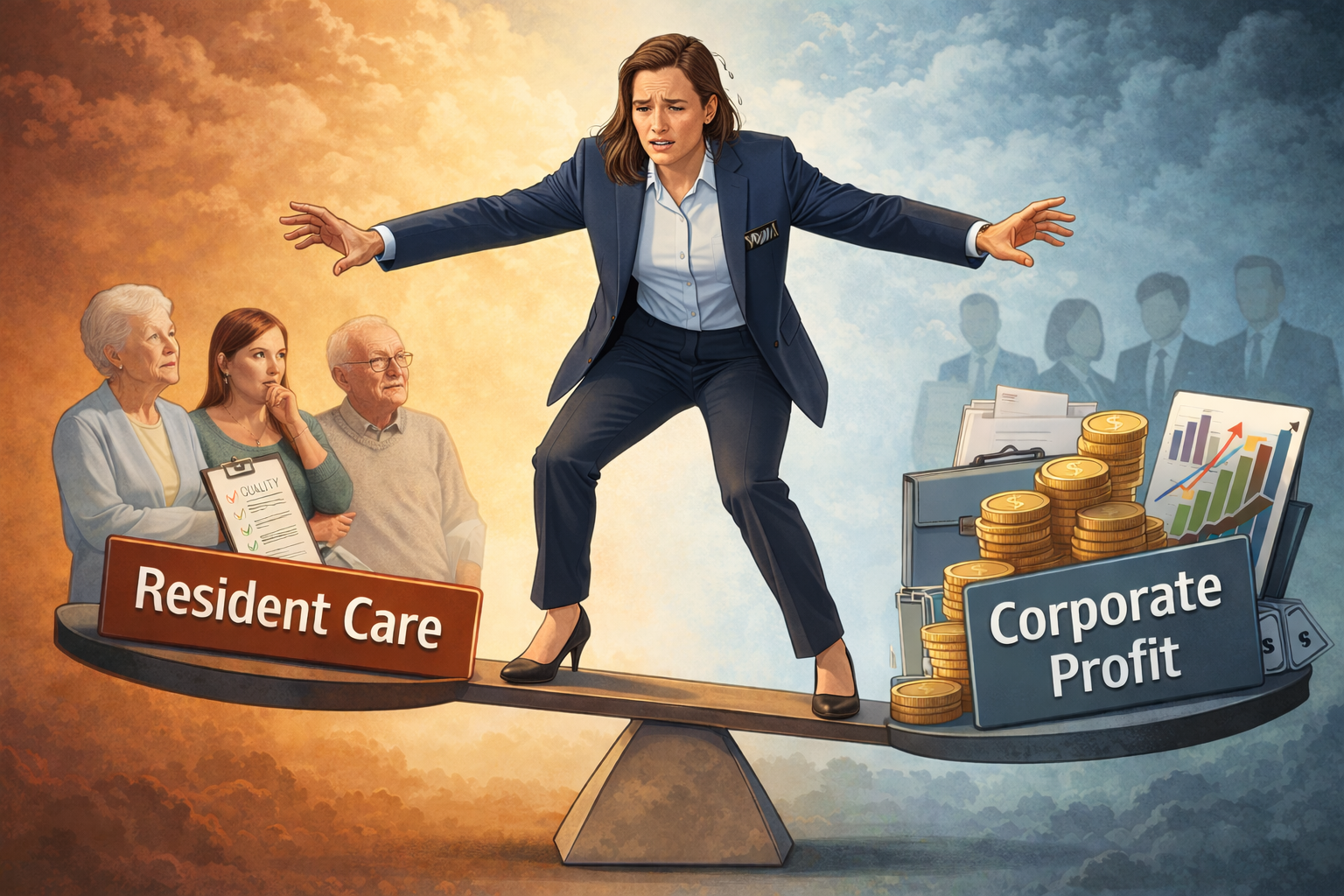
When an Executive Director is told, implicitly or explicitly, that financial results must be delivered regardless of contextual realities—staffing shortages, resident acuity, community morale—the leader experiences internal conflict.
They are asked to be both the compassionate guardian of vulnerable elders and the uncompromising driver of financial performance.
With this set as the expectation – is leadership cloudy?
The Cost of Mixed Signals and Cloudy Leadership
If corporate messaging emphasizes compassion publicly but rewards only financial metrics privately, EDs quickly recognize the true priority.
This creates several risks:
Moral distress — when leaders feel pressured to make decisions that conflict with their values.
Confused culture — when staff hear “resident first” but experience cost-cutting first.
Erosion of trust — when families sense inconsistency.
Compassion fatigue — when leaders absorb the emotional strain of trying to satisfy both worlds without clarity.
Over time, the ED begins to feel like they are standing in the middle of two opposing forces rather than leading with unified direction.
Profit sustains the mission—but the mission must define the profit.
When organizations fail to clearly articulate how financial performance supports compassionate care (rather than competes with it), EDs are left to reconcile that tension alone.
And that tension is exhausting.
What Is Compassion Fatigue?
Deep emotional investment and constant care for others places leaders at risk of compassion fatigue—when the ongoing responsibility for residents, families, and staff begins to quietly drain the very empathy that makes them exceptional leaders?
Executive Directors in senior living are at high risk for emotional exhaustion because, even without providing hands-on care, they carry immense emotional responsibility. They form close relationships with residents and families and regularly witness aging, decline, grief, and death—experiences that accumulate over time.
They often serve as the emotional buffer for families coping with fear, guilt, and uncertainty, while simultaneously leading teams who are managing stress, staffing shortages, and concerns about resident safety.
As the final decision-maker in a highly regulated, high-stakes environment, the ED is the person everyone turns to when something goes wrong. EDs suffer most when the building is in constant crisis.
Preventing compassion fatigue includes operational strategies including technology assistance, staffing pipelines, strong clinical partnership, predictable schedules and clear communication channels and well trained department head who can absorb stress and not simply pass it upward.
Kerry Chartrand, Founder Wentoo; a system of record for compliance execution across Senior Care, is all too familiar with the breaking points for EDs and the struggle in senior care. "One of the quietest contributors to compassion fatigue is the mental load that doesn't clock out, says Chartrand. It's the 2am worry that something slipped through the cracks during a difficult shift, a family concern that wasn't followed up on, a promise made in a hard moment that got lost in the chaos of the next crisis."
Wentoo was built specifically for Executive Directors knowing first-hand their exceptional ability of absorbing pressure.
What compounds the exhaustion isn't just the volume of what they carry — it's the uncertainty of what they might have missed. Peace of mind isn't a luxury for this role — it's a precondition for sustainable leadership.
Organizational Support Must Be Real and Structured
Peer community has been highlighted as an effective tool for stress reduction in multiple management studies. Regular ED circles, mentors or peer cohorts give EDs a protected space to vent safely, gain perspective without isolating and reduce the sense of carrying the load.
Operational rest strategies that are built as structural rather than the reactive one-time wonders of self-care. Examples of these strategies include; protected, meeting-free hours weekly, boundaries around after-hours calls, delegation protocols for evenings/weekends, guaranteed vacation coverage, and rotating “resident relations days” so the ED isn’t the emotional container five days a week.
The ED role cannot rely solely on personal resilience. Operators must provide leadership training, coaching and support, regional guidance that does not blame or shame and realistic KPIs that measure quality, staffing, and culture—not only occupancy.
Compassion fatigue is preventable when organizations treat leadership well-being as a strategic priority.
The Path Forward: Integration, Not Opposition
The most stable organizations do not frame compassion and profitability as enemies.
They define them as interdependent:
- Stable staffing improves quality and reduces turnover costs.
- Strong culture improves occupancy through reputation.
- Resident satisfaction reduces regulatory risk.
- Leadership stability protects long-term returns.
When corporate leadership clearly communicates that long-term financial strength flows from compassionate, high-quality operations—not from short-term cost pressure—EDs regain clarity.
They can lead confidently, knowing the mission and the margin are aligned. A community can only be as healthy as the leaders who guide it.
I've built some highly targetted training supports for Executive Directors and General Managers. My complimentary webinar on Leading the Revenue Team to Success is a 45-minute video that delivers incredible value on building high-performance occupancy teams. You can access it below.
Leading the Revenue Team to Success
Want to connect? Send me an email [email protected] Happy to provide a 30-minute free consultation - let's talk about what you need face-to-face.
Until next time, my warmest regards,
Jodi



Responses