

The Sales Professional’s Field Notes
Why the seniors who will move-in next are already in your database — and how a simple three-cycle rhythm will keep you in relationship with them until they're ready.
The 200-Day Reality
The latest information we have today supports the average time between a senior's initial inquiry and their actual move-in to exceed 200 days with an additional 41 days spent invisible within your digital footprint. Let that sink in for a moment. Nearly eight months of thinking time, decision time, family conversations, home preparations, legal and financial arrangements — all while the person you first spoke with is quietly asking themselves, "Am I really ready for this?"
This is the reality of selling in senior living, and it is unlike any other sales environment. There is no quick close, no impulse buy, no one-call conversion. What there is — if you do the work — is a long arc of relationship, trust-building, and patient guidance that results in a move-in when the senior is ready, not when you need the occupancy.
The sales professional's job is not to push people through the door. It is to keep them moving forward on their journey — to be the guide they trust, the steady voice they return to, and the person who makes the transition feel manageable rather than overwhelming.
That work has a name. It is called follow-up. And most sales teams do it poorly, inconsistently, or not at all.
- v 268 Average days from inquiry to move-in
- v Prospect needs 5–7 In-person visits typical
- v 41 days conducting research within your digital footprint
A System Simple Enough to Execute. Powerful Enough to Transform Occupancy.
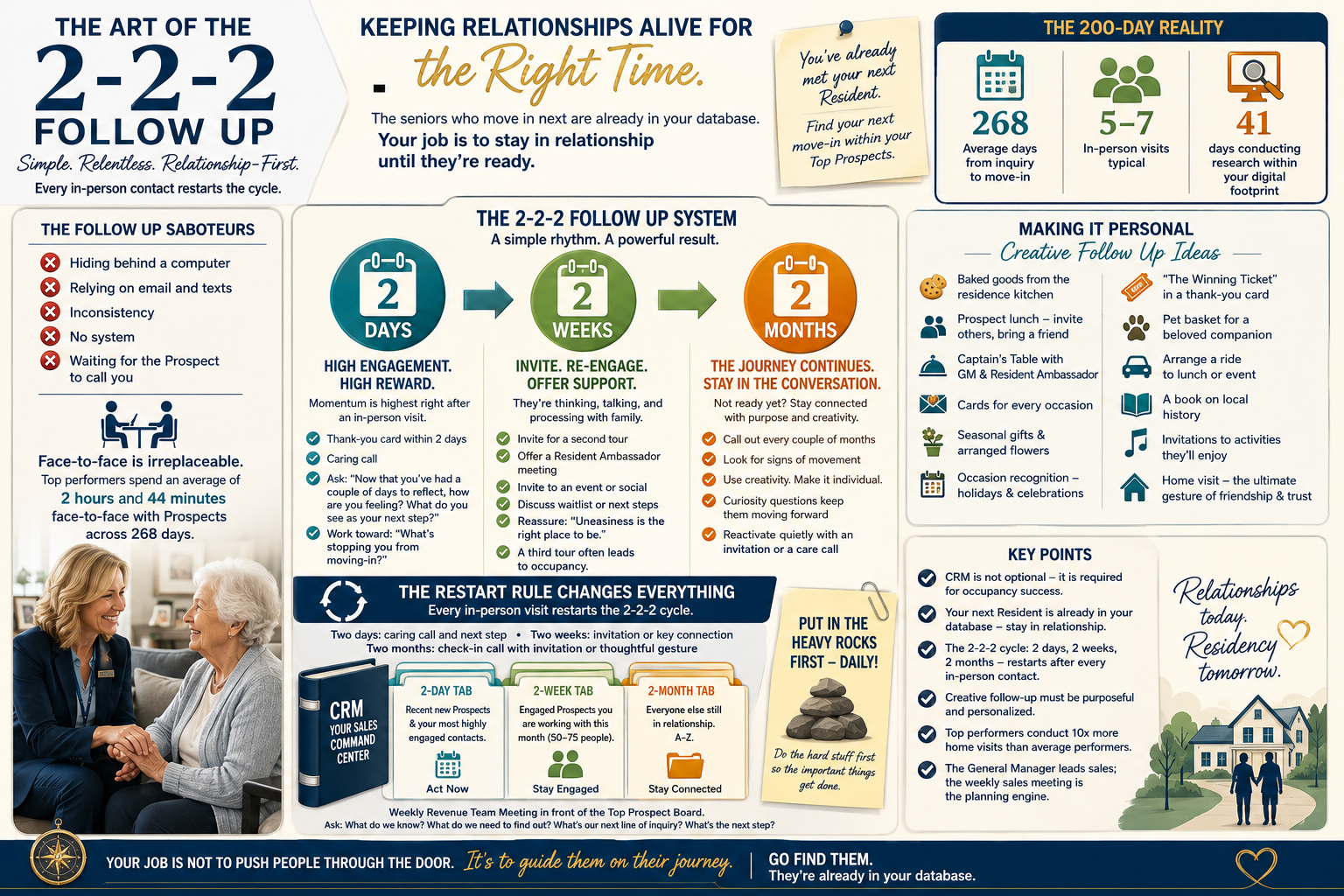
The 2-2-2 Follow Up System is built on a single organizing principle: every meaningful in-person contact with a Prospect restarts a three-stage follow up cycle. Two days, two weeks, two months. Each stage has a distinct purpose and a distinct energy. Together, they ensure that no engaged Prospect ever goes quiet simply because you neglected to call.
This is not a checklist. It is not a script. It is a rhythm — a professional cadence that keeps you in relationship with the 60 to 70 Prospects a senior living sales professional carries at any given time, without losing the personalization that makes each Prospect feel seen and remembered.
"The initial phone call and visit is a measure of marketing success. Subsequent visits and follow-up are a measure of sales success."
2 Days
Moments of high engagement and high reward for action.
Momentum is highest immediately after any in-person visit. The two-day follow up captures that energy before it dissipates. A thank-you card sent within two days of a first tour is not optional — it is a cornerstone of the relationship.
Ask: "Now that you've had a couple of days to reflect, how are you feeling? What do you see as your next step?" and work your conversation towards “What’s stopping you from moving-in?”
2 Weeks
Respectfully allowing seniors to process information while remaining a guiding presence.
Two weeks in, your Prospect is thinking, processing, and often talking with family and others. This stage is about invitation and re-engagement that comforts with support and experience. Getting a second tour and offering reassurance that uneasiness or questioning is absolutely the “right place to be” at this stage is incredibly valuable. A third tour is almost certain to result in an occupancy outcome.
Offer a meeting with a Resident Ambassador who has gone through this thinking stage themselves who has real life experience to share, an invitation to a Friday evening social, or understanding the waitlist conversation. Give them something tangible to move toward.
2 Months
Ready is not a date on the calendar. It is a journey.
Not until you’ve exhausted the back and forth that happens with 2 Days and 2 Weeks, allow for Prospects still on the journey — still engaged, still reacting to your attempts — the two-month cycle. A consistent and careful call out every couple months keeps the relationship alive. Look for signs of movement. Use creativity. Make it individual.
Throughout this time enlist curiosity questions to keep seniors moving forward. Activating conversations help keep people moving forward when they are certain that it makes sense and yet struggle with the decision.
Reactivate quiet leads with an invitation or a care call. The cycle restarts with every in-person visit.
The Critical Detail
The Restart Rule Changes Everything
Here is the principle that elevates 2-2-2 from a simple follow-up schedule into a genuine sales system: the cycle restarts after every in-person meeting.
Every time a Prospect walks through your door, joins you for lunch, attends an event, or receives you for a home visit, the clock resets. Two days: a caring call that establishes a next step. Two weeks: an invitation to visit or introduction to a key contact who can support the move transition. Two months: a call with an invitation to visit — or a creative gesture that reminds them you haven't forgotten.
This means that a Prospect can be in the 2-2-2 cycle for months — years, even — and still receive consistent, personalized, meaningful contact. The relationship deepens rather than fades. Trust accumulates. And when the moment arrives that the senior is truly ready to make the move, you are the person they think of first.
"You've already met your next Resident. Find your next move-in within the Top Prospects in your CRM or 2-2-2 binder."
Making It Personal
Creative Follow Up: The Relationship Does the Work
The 2-2-2 system provides the cadence. What you fill it with must come from the relationship you have built. There are no fixed creative follow-up ideas — they are all personal. The moment follow up becomes formulaic, it loses the power that makes it effective.
What follows are not prescriptions. They are starting points. The best idea is always the one that honours what you know about this specific person.
- Baked goods from the residence kitchen — cookies, muffins, a brown bag lunch
- A Prospect lunch: invite everyone you've toured this week; have them bring a friend
- Captain's Table: highly engaged Prospects dine with the GM and a Resident Ambassador
- Cards for every occasion — thank you, get well, happy birthday, thinking of you
- Seasonal gifts: arranged flowers, potted plants, summertime hanging baskets
- Occasion recognition: Christmas, Valentine's, Thanksgiving, Remembrance Day
- A lottery ticket tucked inside a thank-you card — "The Winning Ticket"
- A pet basket for a Prospect with a beloved animal companion
- Arrange the residence vehicle — or an Uber — to collect them for lunch
- A book on local history for a Prospect with historical interests
- Invitations to specific residence activities they would genuinely enjoy
- A home visit — the ultimate gesture of friendship and trust
Top-performing sales professionals in this industry conduct ten times as many home visits as average performers. A home visit is an act of care. It builds trust at a depth that no phone call or email can match. Use it wisely — know the Prospect's personality before you arrive at the door — but do not be afraid of it.
The Saboteurs of Follow Up
The most common failure in senior living sales is not a lack of leads. It is hiding behind a computer. Emails and texts are efficient — they are not effective. When in doubt, call. When you can, visit. The relationship that earns a move-in is built face-to-face.
Top performers in this industry spent an average of 2 hours and 44 minutes face-to-face with Prospects across 268 days of work. That is the number you are trying to replicate.
The System Behind the System
CRM: Paper or Digital, It Must Be Used
The 2-2-2 system lives inside a Customer Relationship Management structure — whether that is a dedicated software platform or a well-organized three-ring binder with A–Z dividers, a two-day tab, a two-week tab, and a two-month section. The tool matters far less than the habit of using it.
The two-day tab holds all recent new Prospects and your most highly engaged contacts. The two-week tab holds all engaged Prospects you are working with this month — typically 50 to 75 people, organized alphabetically. The two-month, A-Z section carries everyone else still in relationship.
No matter what your system is – it must be used to be effective.
Put in the heavy rocks first – and that means daily! Which loosely translates to do the hard stuff first to ensure your discipline to complete the tactics that make a difference.
Every week, the Revenue Team gathers in front of the Top Prospect Board, CRM binder open, to ask the same questions about each Prospect: What do we know? What do we need to find out? What is the next line of inquiry? What is the next step? The answers to those questions drive the cycle of follow-up.
For Prospects who have gone truly quiet — those not responding to any attempts — move them to the inactive database and maintain passive, quarterly contact: digital newsletters, annual open house invitations, seasonal events. The relationship does not end. It simply changes tempo.
Key Points
- Customer Relationship Management is not optional — it is required for occupancy success.
- CRM can be paper or digital; what matters is that it functions as an active sales tool.
- Your next Resident is already in your database — the work is staying in relationship with them.
- Creative follow-up is only effective when it is purposeful and personalized to each individual.
- The follow-up cycle moves through 2 days, 2 weeks, and 2 months — restarting after every in-person contact.
- Top performers conduct 10 times as many home visits as average performers.
- The General Manager is the leader of sales; the weekly sales meeting is the planning engine.
Simple. Relentless. Relationship-First
The 2-2-2 system is not hard. It is not complicated. In fact, it's so simple it is sometimes overlooked as a critical point for success.
What it requires is consistency — and the belief that the person on the other end of your follow-up call is worth the effort, regardless of where they are in their journey.
The seniors who move into your residence next are not strangers. They are already in your database. Go find them.
— Jodi Flanagan



Responses